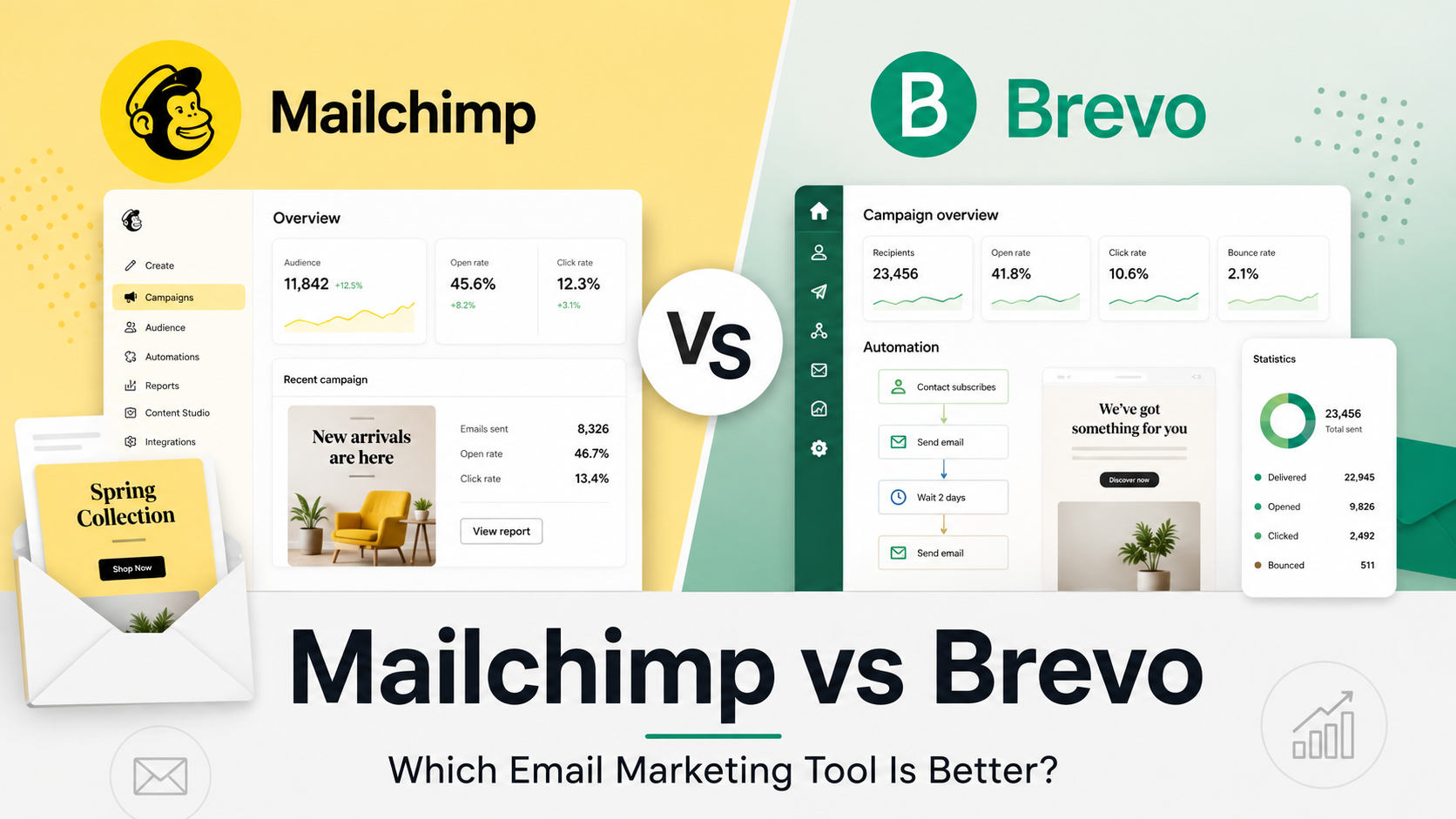
Mailchimp vs Brevo: Which Email Marketing Tool Is Better?
A direct comparison for teams weighing Mailchimp brand familiarity against Brevo contact-friendly pricing and multi-channel tools.
By Ivy WhitmorePublished Jul 17, 2026Updated Jul 17, 202615 min read
Product buttons link to official websites and may be sponsored if a partner relationship is active. Editorial conclusions are based on visible criteria and sources.
You want a familiar email builder and polished newsletter templates.
Your contact list is small enough that contact-tier pricing remains comfortable.
You rely on Mailchimp integrations or existing team familiarity.
Brevo
Best for growing lists
Choose Brevo if...
You store many contacts but send moderate email volume.
You need transactional email, SMS, WhatsApp, or sales CRM features.
You want a free plan with a larger contact allowance.
Mailchimp is better for beginners who want a familiar email builder, polished templates, and a broad integration ecosystem. Brevo is better for teams with larger contact databases, transactional email needs, SMS or WhatsApp plans, and cost sensitivity around stored contacts.
Quick verdict: Mailchimp is the easier default for simple newsletters. Brevo is the stronger value for growing lists, transactional email, and multi-channel messaging.
Mailchimp vs Brevo at a Glance
Mailchimp
Brevo
Best for
Small businesses that want familiar email marketing and templates
Best for
Teams with larger contact databases and multi-channel messaging
Starting cost
Free up to 250 contacts and 500 sends/month; paid marketing plans scale by contacts.
Ease of use
Very approachable
Starting cost
Free plan with 300 daily email sends and up to 100,000 contacts; Starter from $9/month.
Ease of use
Approachable but broader platform
Customization
Available through Mailchimp Transactional add-on/product
Ownership
Managed platform ownership
Customization
Native transactional email tools
Ownership
Self-hosted ownership and control
Support
SMS add-ons in select markets
Main strength
Recognizable email builder, templates, integrations, and campaign tools
Support
SMS and WhatsApp options
Main strength
Email, SMS, WhatsApp, transactional email, automation, and CRM tools in one platform
Main limitation
Contact-based pricing can become expensive as lists grow
Main limitation
Interface and template ecosystem may feel less familiar than Mailchimp
Available through Mailchimp Transactional add-on/product
Native transactional email tools
Brevo
SMS/WhatsApp
SMS add-ons in select markets
SMS and WhatsApp options
Brevo
Templates
Polished and familiar
Solid but less iconic
Mailchimp
Overall recommendation
Small list newsletters
Contact-heavy and multi-channel teams
Tie by use case
Advertisement
Choose Mailchimp or Brevo If
Choose Mailchimp if:
You want a familiar email builder and polished newsletter templates.
Your contact list is small enough that contact-tier pricing remains comfortable.
You rely on Mailchimp integrations or existing team familiarity.
Choose Brevo if:
You store many contacts but send moderate email volume.
You need transactional email, SMS, WhatsApp, or sales CRM features.
You want a free plan with a larger contact allowance.
Mailchimp vs Brevo: The Main Differences
Mailchimp is primarily recognized as an email marketing platform; Brevo is positioned as multi-channel customer communication.
Mailchimp free plan is limited by contacts and monthly sends; Brevo free plan is limited by daily sends and has a much larger contact allowance.
Brevo has a stronger transactional email and SMS/WhatsApp story.
Mailchimp has stronger brand familiarity, templates, and a large integration ecosystem.
Brevo can be more cost-effective for contact-heavy databases.
Detailed Category-by-Category Report
01
Contact Management
Mailchimp organizes audiences, segments, tags, forms, and contact profiles around marketing lists. It is friendly for beginners, but unsubscribed and non-subscribed contacts can affect billing unless managed carefully. Brevo allows a much larger contact store on the free plan, making it attractive for teams that collect many leads but do not email all of them every month.
Mailchimp
Mailchimp organizes audiences, segments, tags, forms, and contact profiles around marketing lists.
Brevo
Brevo allows a much larger contact store on the free plan, making it attractive for teams that collect many leads but do not email all of them every month.
Key differenceWinner for contact-heavy lists: Brevo.
02
Email Builder and Templates
Mailchimp has long been known for approachable campaign creation and strong templates. Brevo also has a drag-and-drop editor and templates, but Mailchimp still feels more polished for brand-focused newsletters. For teams whose main job is a weekly campaign, Mailchimp remains very comfortable.
Mailchimp
Mailchimp has long been known for approachable campaign creation and strong templates. Brevo also has a drag-and-drop editor and templates, but Mailchimp still feels more polished for brand-focused newsletters.
Brevo
Brevo also has a drag-and-drop editor and templates, but Mailchimp still feels more polished for brand-focused newsletters.
Key differenceWinner for newsletter design familiarity: Mailchimp.
03
Automation and Segmentation
Both platforms support marketing automation and segmentation, but packaging matters. Mailchimp pushes more advanced journeys into higher paid tiers. Brevo includes marketing automation with plan limits and is often attractive when automation touches email, transactional messaging, and sales workflows.
Mailchimp
Mailchimp pushes more advanced journeys into higher paid tiers.
Brevo
Brevo includes marketing automation with plan limits and is often attractive when automation touches email, transactional messaging, and sales workflows.
Key differenceBest choice depends on automation depth and channel mix.
04
Transactional Email and SMS
Brevo has a clearer all-in-one story for transactional email, SMS, WhatsApp, and campaign messaging. Mailchimp can support transactional email through separate Mailchimp Transactional capabilities, but many small marketers experience it as a separate lane. If order confirmations, password emails, and campaign messages need to live together, Brevo is the cleaner fit.
Mailchimp
Mailchimp can support transactional email through separate Mailchimp Transactional capabilities, but many small marketers experience it as a separate lane.
Brevo
Brevo has a clearer all-in-one story for transactional email, SMS, WhatsApp, and campaign messaging. If order confirmations, password emails, and campaign messages need to live together, Brevo is the cleaner fit.
Key differenceWinner for transactional and multi-channel messaging: Brevo.
05
Reporting and Ecommerce
Mailchimp integrates with ecommerce platforms and provides campaign reporting, automations, and customer insights. Brevo also supports ecommerce integrations and reporting, with more emphasis on contact activity across channels. Stores should compare the exact integration for their ecommerce platform before switching.
Mailchimp
Mailchimp integrates with ecommerce platforms and provides campaign reporting, automations, and customer insights.
Brevo
Brevo also supports ecommerce integrations and reporting, with more emphasis on contact activity across channels.
Key differenceTie, with Mailchimp stronger for familiar ecommerce marketing workflows.
06
Pricing and List Growth
Mailchimp pricing scales by selected contact tier and send limits. Brevo pricing emphasizes monthly email sends and includes a large free contact allowance. For a business with a large CRM list and moderate campaigns, Brevo may be cheaper. For a small list that values Mailchimp templates, Mailchimp can still be reasonable.
Mailchimp
Mailchimp pricing scales by selected contact tier and send limits. For a small list that values Mailchimp templates, Mailchimp can still be reasonable.
Brevo
Brevo pricing emphasizes monthly email sends and includes a large free contact allowance. For a business with a large CRM list and moderate campaigns, Brevo may be cheaper.
Key differenceWinner for larger stored contact databases: Brevo.
Advertisement
Full Feature Comparison Table
Mailchimp vs Brevo full feature comparison
Feature or criterion
Mailchimp
Brevo
Winner
Free contact allowance
Up to 250 contacts
Up to 100,000 contacts
Brevo
Free sends
500/month with daily limit
300/day
Depends on send pattern
Entry paid price
Essentials from $13/month for base tier
Starter from $9/month
Brevo
Email builder
Very strong
Strong
Mailchimp
Templates
Large familiar library
Good library
Mailchimp
Audience segmentation
Strong
Strong
Tie
Automations
Advanced features by plan
Automation with plan limits
Tie
Transactional email
Separate/related product path
Native platform strength
Brevo
SMS
Add-on in select locations
Available
Brevo
WhatsApp
Limited/add-on path
Available on supported plans/add-ons
Brevo
Forms
Built in
Built in
Tie
Landing pages
Available
Plan-dependent
Mailchimp
CRM/sales tools
Marketing CRM focus
Built-in sales features
Brevo
Reporting
Campaign reporting and analytics
Campaign and platform reporting
Tie
Ecommerce integrations
Broad ecosystem
Available integrations
Mailchimp broader
Deliverability tools
Standard email platform controls
Campaign and transactional tooling
Tie
Branding on free plan
Mailchimp branding/limits apply
Brevo branding/limits apply
Tie
Best for newsletters
Strong
Good
Mailchimp
Best for multi-channel
Moderate
Strong
Brevo
Cost predictability
Can rise with contacts
Can rise with sends/add-ons
Depends on usage
Pricing Comparison
Pricing checked:
Pricing checked on 2026-08-01. Mailchimp lists a Free Marketing plan with up to 250 contacts and 500 monthly sends, and paid plans that scale by contact tier. Brevo lists a Free plan with 300 daily sends and up to 100,000 contacts, with Starter from $9/month. Taxes, annual discounts, add-ons, SMS, WhatsApp, dedicated IPs, and contact or send tiers can change the total.
Mailchimp
Brevo
Platform or software
Free up to 250 contacts and 500 sends/month; paid marketing plans scale by contacts.
Platform or software
Free plan with 300 daily email sends and up to 100,000 contacts; Starter from $9/month.
Optional costs
Contact-based pricing can become expensive as lists grow
Optional costs
Interface and template ecosystem may feel less familiar than Mailchimp
First-year planning note
Small teams prioritizing newsletter design and ecosystem familiarity
First-year planning note
Growing marketers who care about send volume, CRM, and transactional messaging
Mailchimp becomes more expensive as contact tiers rise.
Brevo is often more attractive when stored contacts exceed campaign send volume.
Mailchimp may be simpler for very small newsletters.
Brevo add-ons such as sales packages, extra seats, branding removal, or dedicated IPs can increase cost.
Both tools require periodic pricing verification before publication updates.
Pros and Cons
Mailchimp
Pros
Familiar email editor and templates.
Broad integrations and brand recognition.
Good fit for small newsletter programs.
Cons
Free plan is limited for growing lists.
Contact-based pricing can surprise teams.
Transactional and multi-channel needs may require separate decisions.
Brevo
Pros
Generous contact allowance on the free plan.
Strong transactional email, SMS, WhatsApp, and sales-tool story.
Often better value for contact-heavy databases.
Cons
Templates and brand familiarity trail Mailchimp.
Daily send limits matter on free plan.
Add-ons can complicate pricing.
Use-case recommendations
Find the right fit for your team
Different teams have different priorities. Here's how Mailchimp and Brevo compare for common use cases.
simple newsletters
Mailchimp
Recommended
Mailchimp, because the editor and templates are familiar.
Why: The editor and templates are familiar.
large contact lists
Brevo
Recommended
Brevo, because contact storage is more generous on the free plan.
Why: Contact storage is more generous on the free plan.
ecommerce messaging
Mailchimp
Recommended
Mailchimp for classic promotional campaigns; Brevo for transactional and multi-channel flows.
Also consider: Brevo for transactional and multi-channel flows.
limited budgets
Mailchimp
Recommended
Brevo when contacts are high and sends are moderate; Mailchimp when the list is very small.
Also consider: Mailchimp when the list is very small.
Bottom line: Mailchimp is the easier default for simple newsletters. Brevo is the stronger value for growing lists, transactional email, and multi-channel messaging.
The riskiest step is DNS and deliverability setup, so warm up sending carefully after migration.
Main risks and checklist
Export products, customers, orders, content, and redirects before rebuilding workflows.
Identify theme, checkout, form, automation, and reporting behavior that may require manual recreation.
Test URL redirects and analytics before switching live traffic.
Alternatives to Consider
Klaviyo
MailerLite
ActiveCampaign
Constant Contact
Frequently Asked Questions
Brevo is better for many teams with larger contact lists, transactional email needs, SMS, or WhatsApp. Mailchimp is better for simple newsletters, familiar templates, and teams already comfortable with its ecosystem.
Brevo has the more generous free contact allowance and a daily send limit. Mailchimp free is useful for very small lists but is limited by both contacts and monthly sends.
Mailchimp can become more expensive as contact counts grow. Brevo can be cheaper for large stored lists with moderate send volume, though add-ons and higher send tiers can change the math.
Both support automation. Mailchimp is comfortable for marketing journeys, while Brevo is stronger when automation includes transactional email, CRM activity, SMS, or WhatsApp.
Yes. Export contacts, tags, unsubscribes, templates, and automation logic, then rebuild forms, DNS authentication, and workflows in Brevo. Test deliverability before switching all campaigns.
Mailchimp is strong for promotional ecommerce campaigns and integrations. Brevo is strong when ecommerce messaging includes transactional email, SMS, WhatsApp, and CRM follow-up.
Editorial Methodology and Sources
We reviewed official pricing and help documentation, plan limits, email builder workflows, automation packaging, contact and send limits, transactional email support, SMS/WhatsApp availability, ecommerce integrations, and total cost drivers.