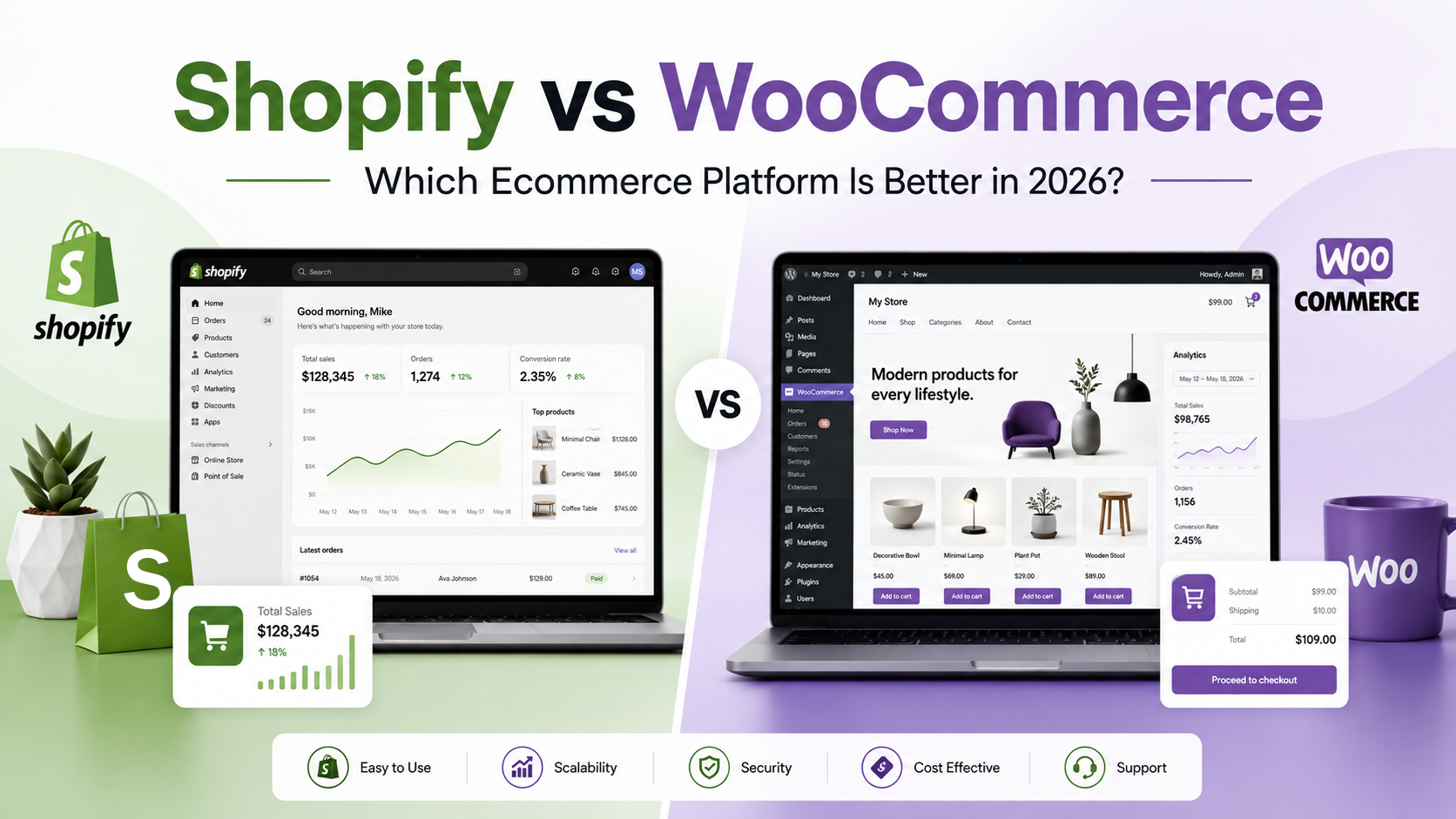
Shopify vs WooCommerce: Which Ecommerce Platform Is Better in 2026?
A practical ecommerce comparison for founders choosing between a hosted selling platform and an open-source WordPress store.
By Alex MarcyPublished Jul 20, 2026Updated Jul 20, 202617 min read
This comparison contains links to official product websites. Some outbound links may be sponsored if a partner relationship is active; editorial recommendations are based on the criteria below.
You want to launch a store without configuring hosting or WordPress.
You prefer one vendor for checkout, payments, support, and core store tools.
You need a polished buying experience and predictable operational maintenance.
WooCommerce
Best for control
Choose WooCommerce if...
You already run WordPress and want ecommerce inside the same CMS.
You need deep theme, plugin, hosting, or data control.
You have developer help or are comfortable maintaining a self-hosted stack.
Shopify is better for most beginners because hosting, checkout, payments, security, inventory, themes, and support live in one managed platform. WooCommerce is better for advanced users, content-led brands, and teams that want WordPress-level control over code, hosting, data ownership, and extensions.
Quick verdict: Shopify is the default recommendation for new stores that need to launch quickly. WooCommerce is the stronger fit for WordPress-first businesses and teams with technical support.
Shopify vs WooCommerce at a Glance
Shopify
WooCommerce
Editorial score
9.1 / 10
Editorial score
8.7 / 10
Best for
Beginners and growing stores that want managed ecommerce
Best for
WordPress stores that need ownership and deep customization
Starting cost
Basic from $29/month when billed yearly; monthly billing is higher.
Ease of use
Guided setup and centralized admin
Starting cost
Free core plugin; hosting, extensions, processing, and maintenance vary.
Ease of use
Familiar to WordPress users, but more moving parts
Customization
Theme and app based with platform limits
Ownership
Managed platform ownership
Customization
Deep code and plugin control
Ownership
Self-hosted ownership and control
Support
Platform support from Shopify
Main strength
Hosted checkout, payments, themes, apps, and support in one system
Support
Community, host, extension vendor, or agency support
Main strength
Open-source flexibility with a large WordPress extension ecosystem
Main limitation
Less freedom over hosting and back-end architecture
Main limitation
Requires hosting, updates, security, and plugin decisions
Familiar to WordPress users, but more moving parts
Shopify
Pricing model
Monthly platform plan plus processing and apps
Free core plugin plus hosting and extensions
Depends on stack
Free plan
Trial/promotional offers, not a permanent free store plan
Free plugin
WooCommerce
Setup difficulty
Low
Medium
Shopify
Customization
Theme and app based with platform limits
Deep code and plugin control
WooCommerce
Support
Platform support from Shopify
Community, host, extension vendor, or agency support
Shopify
Scalability
Managed scaling on higher plans
Scales with hosting and engineering quality
Depends on team
Main advantage
Predictable hosted commerce
Ownership and extensibility
Tie
Main disadvantage
Platform constraints and app costs
Maintenance burden
Tie
Advertisement
Choose Shopify or WooCommerce If
Choose Shopify if:
You want to launch a store without configuring hosting or WordPress.
You prefer one vendor for checkout, payments, support, and core store tools.
You need a polished buying experience and predictable operational maintenance.
Choose WooCommerce if:
You already run WordPress and want ecommerce inside the same CMS.
You need deep theme, plugin, hosting, or data control.
You have developer help or are comfortable maintaining a self-hosted stack.
Shopify vs WooCommerce: The Main Differences
Shopify is hosted; WooCommerce is self-hosted through WordPress.
Shopify bundles checkout, security, hosting, and admin updates; WooCommerce asks the merchant to assemble and maintain those layers.
Shopify costs are easier to forecast, while WooCommerce costs depend on hosting quality, extensions, and agency support.
WooCommerce usually wins for code-level customization and ownership; Shopify usually wins for operational simplicity.
Shopify has stronger native commerce workflows, while WooCommerce benefits from WordPress publishing and plugin flexibility.
Detailed Category-by-Category Report
01
Ease of Use
Shopify is designed around a guided store owner workflow. Products, collections, checkout settings, payments, shipping, discounts, and apps are managed from one admin. WooCommerce feels more familiar to a WordPress publisher, but a new merchant must also understand hosting, themes, plugins, backups, caching, and security. That extra control is useful, but it raises the setup burden.
Shopify
Shopify is designed around a guided store owner workflow.
WooCommerce
WooCommerce feels more familiar to a WordPress publisher, but a new merchant must also understand hosting, themes, plugins, backups, caching, and security.
Key differenceWinner for ease of use: Shopify.
02
Store Setup and Maintenance
Shopify reduces setup to account creation, theme selection, product entry, payment configuration, and domain connection. Updates happen on the platform side. WooCommerce setup starts with a WordPress installation and continues through hosting, SSL, theme selection, plugin compatibility, payment extensions, and update routines. Teams that already maintain WordPress may find this normal; first-time sellers often find it slower.
Shopify
Shopify reduces setup to account creation, theme selection, product entry, payment configuration, and domain connection.
WooCommerce
WooCommerce setup starts with a WordPress installation and continues through hosting, SSL, theme selection, plugin compatibility, payment extensions, and update routines.
Key differenceWinner for low-maintenance setup: Shopify.
03
Product Management and Checkout
Both platforms can handle physical products, digital products, categories, variants, discounts, coupons, taxes, and shipping workflows. Shopify has a more standardized checkout and selling-channel story. WooCommerce can be shaped heavily with extensions, but checkout quality depends on the theme, plugins, and hosting performance.
Shopify
Shopify has a more standardized checkout and selling-channel story.
WooCommerce
WooCommerce can be shaped heavily with extensions, but checkout quality depends on the theme, plugins, and hosting performance.
Key differenceWinner for checkout consistency: Shopify.
04
Themes, Apps, and Extensions
Shopify themes and apps are curated around commerce, which keeps the ecosystem focused but can create recurring app costs. WooCommerce inherits the vast WordPress theme and plugin market. That gives developers more freedom, but plugin selection and compatibility become part of the editorial and technical responsibility.
Shopify
Shopify themes and apps are curated around commerce, which keeps the ecosystem focused but can create recurring app costs.
WooCommerce
WooCommerce inherits the vast WordPress theme and plugin market.
Key differenceWinner for controlled commerce apps: Shopify; winner for extension freedom: WooCommerce.
05
SEO and Content
Shopify supports core ecommerce SEO needs such as editable titles, product metadata, redirects, structured product data through themes and apps, and fast hosted pages. WooCommerce sits inside WordPress, so content-heavy brands can combine product pages with a powerful publishing system and SEO plugins. For stores where organic editorial content is central, WooCommerce has a real advantage.
Shopify
Shopify supports core ecommerce SEO needs such as editable titles, product metadata, redirects, structured product data through themes and apps, and fast hosted pages.
WooCommerce
WooCommerce sits inside WordPress, so content-heavy brands can combine product pages with a powerful publishing system and SEO plugins. For stores where organic editorial content is central, WooCommerce has a real advantage.
Key differenceWinner for content-led SEO: WooCommerce.
06
Security, Hosting, and Performance
Shopify handles platform hosting, core security, and payment infrastructure as part of the service. WooCommerce security depends on the store owner, host, theme, plugin quality, update discipline, and backup process. A well-run WooCommerce store can perform very well, but the work belongs to the merchant or their technical partner.
Shopify
Shopify handles platform hosting, core security, and payment infrastructure as part of the service.
WooCommerce
WooCommerce security depends on the store owner, host, theme, plugin quality, update discipline, and backup process. A well-run WooCommerce store can perform very well, but the work belongs to the merchant or their technical partner.
Key differenceWinner for managed security and performance: Shopify.
07
Pricing and Total Cost
Shopify has published platform tiers, payment processing rates, and possible app costs. WooCommerce has no core platform subscription and advertises no revenue share, but a serious store still pays for hosting, payment processing, extensions, developer help, premium themes, and maintenance. WooCommerce can be less expensive for a lean WordPress store; Shopify can be less expensive than a custom WooCommerce build once maintenance is counted.
Shopify
Shopify has published platform tiers, payment processing rates, and possible app costs. WooCommerce can be less expensive for a lean WordPress store; Shopify can be less expensive than a custom WooCommerce build once maintenance is counted.
WooCommerce
WooCommerce has no core platform subscription and advertises no revenue share, but a serious store still pays for hosting, payment processing, extensions, developer help, premium themes, and maintenance. WooCommerce can be less expensive for a lean WordPress store; Shopify can be less expensive than a custom WooCommerce build once maintenance is counted.
Key differenceBest choice depends on cost profile: WooCommerce for lean self-managed stores; Shopify for predictable managed operations.
08
Scalability
Shopify scales through managed plans and higher-tier commerce features. WooCommerce scales through hosting architecture, database quality, caching, plugin discipline, and developer operations. A technical team can make WooCommerce scale, but nontechnical merchants generally get an easier scaling path from Shopify.
Shopify
Shopify scales through managed plans and higher-tier commerce features. A technical team can make WooCommerce scale, but nontechnical merchants generally get an easier scaling path from Shopify.
WooCommerce
WooCommerce scales through hosting architecture, database quality, caching, plugin discipline, and developer operations. A technical team can make WooCommerce scale, but nontechnical merchants generally get an easier scaling path from Shopify.
Key differenceWinner for nontechnical scaling: Shopify.
Advertisement
Full Feature Comparison Table
Shopify vs WooCommerce full feature comparison
Feature or criterion
Shopify
WooCommerce
Winner
Core platform
Hosted ecommerce platform
WordPress ecommerce plugin
Different architecture
Hosting
Included with platform
Merchant chooses host
Shopify simpler
Security updates
Managed by Shopify
Managed by site owner, host, and plugin vendors
Shopify simpler
Checkout
Hosted and standardized
Theme/plugin dependent
Shopify more consistent
Payment gateways
Shopify Payments and third-party gateways
WooPayments and many gateways
Both strong
Third-party payment fees
May apply by plan when not using Shopify Payments
No WooCommerce platform revenue share; processor fees still apply
WooCommerce
Product variants
Built in
Built in
Tie
Shipping tools
Built in with plan-dependent features
Built in plus extensions
Depends on needs
Tax tools
Built in and app supported
Built in and extension supported
Tie
Themes
Commerce-focused theme store
WordPress theme ecosystem
WooCommerce broader
Apps/extensions
Shopify App Store
WordPress/WooCommerce extensions
WooCommerce broader
Blogging
Basic built-in blog
WordPress publishing system
WooCommerce
SEO control
Good commerce SEO controls
Deep WordPress SEO plugin ecosystem
WooCommerce
International selling
Available through Shopify features and apps
Available through extensions and setup
Depends on plan/stack
Inventory
Built in
Built in plus extensions
Tie
Maintenance
Low merchant burden
Ongoing owner responsibility
Shopify
Developer control
Theme/app APIs with platform limits
Open-source code control
WooCommerce
Support path
Central Shopify support
Host, community, vendor, or agency support
Shopify simpler
Best beginner fit
Strong
Moderate
Shopify
Best advanced fit
Strong for managed scale
Strong for custom WordPress builds
Depends on team
Pricing Comparison
Pricing checked:
Pricing checked on 2026-08-01. Shopify publishes paid ecommerce tiers, with Basic listed from $29/month when billed yearly on the official pricing page at the time checked. WooCommerce says the core platform is free and open source, with hosting, extensions, and payment processing making up most store costs.
Shopify
WooCommerce
Platform or software
Basic from $29/month when billed yearly; monthly billing is higher.
Platform or software
Free core plugin; hosting, extensions, processing, and maintenance vary.
Optional costs
Less freedom over hosting and back-end architecture
Optional costs
Requires hosting, updates, security, and plugin decisions
First-year planning note
Retailers that want to launch and operate without managing WordPress infrastructure
First-year planning note
Content-led brands, developers, and teams already invested in WordPress
Shopify costs are more predictable because platform pricing is published by plan.
WooCommerce has no core monthly platform fee, but hosting commonly becomes the base infrastructure cost.
Both platforms still require payment processing fees.
Paid themes, apps, extensions, developer work, and taxes can change the total cost.
Shopify is usually easier to budget; WooCommerce can be cheaper when the store remains technically lean.
Pros and Cons
Shopify
Pros
Fastest path from idea to live checkout.
Centralized support and managed platform operations.
Strong native commerce workflows for inventory, channels, payments, and checkout.
Cons
Recurring platform plan is required for a serious store.
Advanced customization can hit platform boundaries.
Apps can add meaningful monthly costs.
WooCommerce
Pros
Free core plugin with no platform revenue share.
Deep WordPress content, SEO, and code flexibility.
Store owner controls hosting, data, and extension choices.
Cons
Maintenance, backups, security, and updates need active ownership.
Plugin conflicts can affect checkout quality.
Costs become harder to forecast when extensions and developer support accumulate.
Use-case recommendations
Find the right fit for your team
Different teams have different priorities. Here's how Shopify and WooCommerce compare for common use cases.
beginners
Shopify
Recommended
Shopify, because the setup path and maintenance model are simpler.
Why: The setup path and maintenance model are simpler.
WordPress publishers
WooCommerce
Recommended
WooCommerce, because products can live inside an existing content engine.
Why: Products can live inside an existing content engine.
predictable operations
Shopify
Recommended
Shopify, especially for teams without in-house technical support.
Why: Shopify, especially for teams without in-house technical support.
custom builds
WooCommerce
Recommended
WooCommerce, when a developer will own the stack.
Why: WooCommerce, when a developer will own the stack.
Bottom line: Shopify is the default recommendation for new stores that need to launch quickly. WooCommerce is the stronger fit for WordPress-first businesses and teams with technical support.
Migration and Switching
Moving from WooCommerce to Shopify
Switching from WooCommerce to Shopify usually involves exporting products, customers, orders, redirects, and content, then rebuilding theme and app behavior.
Moving from Shopify to WooCommerce
Moving from Shopify to WooCommerce often means recreating checkout, payment, and theme logic in WordPress.
Main risks and checklist
Export products, customers, orders, content, and redirects before rebuilding workflows.
Identify theme, checkout, form, automation, and reporting behavior that may require manual recreation.
Test URL redirects and analytics before switching live traffic.
Alternatives to Consider
BigCommerce
Wix
Squarespace
Adobe Commerce
Frequently Asked Questions
Shopify is better for beginners and teams that want a managed ecommerce platform. WooCommerce is better for WordPress users and teams that want deeper ownership and customization. The better choice depends on whether simplicity or control matters more.
WooCommerce can be cheaper because the core plugin is free, but hosting, premium extensions, themes, payment processing, maintenance, and developer support can add up. Shopify usually has a more predictable monthly platform cost.
Shopify is easier for beginners because hosting, checkout, security, payments, and support are managed in one place. WooCommerce is approachable for WordPress users but has more technical decisions.
WooCommerce has an edge for content-heavy SEO because it runs on WordPress and can use mature SEO plugins. Shopify is strong for product and collection SEO but less flexible as a publishing system.
Yes, but plan for product, order, customer, URL, redirect, theme, and app differences. A larger store should test migration in a staging process before switching live traffic.
WooCommerce says it does not take a platform revenue share, but payment processors still charge processing fees. Extension or payment provider fees may also apply.
Editorial Methodology and Sources
We compared official pricing pages, product documentation, setup model, maintenance responsibility, checkout workflow, extension ecosystem, SEO flexibility, support paths, and total ownership cost. No fake ratings or customer review counts are used.